How to use business intelligence to fuel restaurant performance

Restaurants generate huge amounts of data every day, but turning that data into better decisions is where many operators struggle.
Business intelligence helps restaurants understand what’s happening across their operations, from sales and labour costs to inventory and profitability, so they can make faster, smarter decisions.
In this article, we explore how restaurant business intelligence works, why AI is changing the way operators use data, and how an agentic AI operating system like Nory can help improve performance.
What is business intelligence for restaurants?
Business intelligence (BI) combines technologies, strategies, and practices to collect and analyse business data. It supports the decision-making process, helping businesses make data-backed decisions that drive success.
It gives businesses a deeper understanding of their operations, customers, markets, and competitors. With the right tools, you can analyse key data points to optimise processes, improve performance, and hit your strategic goals. That’s where restaurant business intelligence software comes in, it helps turn all that data into real, actionable insights so you can make smarter decisions, faster.
Recommended reading: Take a look at how Griolladh grew their business by 3x working with Nory!
How BI improves restaurant performance
By analysing everything from sales and customer behaviour to labour costs and inventory, BI gives you the insights to reduce waste, optimise operations, and identify new opportunities for growth.
Here are some of the restaurant business intelligence benefits that improve the bottom line:
- Optimise prices. BI helps restaurants analyse market trends, customer behaviour, and competitor pricing. With this information, you can create optimal prices for menu items (while still maintaining a competitive edge).
- Generate more revenue. BI spots identify opportunities to upsell, cross-sell, and target promotions effectively. For example, if you can see that cheeseburgers are top-sellers, you might create a promotion with burgers and fries to generate more revenue.
- Provide a better dining experience. Part of the BI process involves analysing customer behaviour, dining patterns, and feedback. As a result, you can enhance the entire dining experience. For example, adding more menu items that suit the preferences of your ideal audience.
- Make smart decisions. BI provides actionable insights, allowing you to make informed decisions about every part of your restaurant operation in real-time. Improve your menu planning, create marketing strategies, and upgrade your operations to cut costs and increase profit margins.
- Reduce food waste. Use BI to track patterns, spot inefficiencies, and make quick decisions to reduce waste before it becomes a problem. For example, adjusting inventory orders to meet demand and prevent over-ordering.
- Improve operations. With business intelligence, you focus on what’s happening now and how to make instant changes to get better results. Nory, for example, tracks daily restaurant performance (even breaking it down hour-by-hour) so you can pinpoint how to maximise efficiency in real-time.
- Identify profitable locations. Restaurant business intelligence shows you which stores are the most profitable. When you spot your most profitable locations, you can use this information to maximise profits and decide when/where you open new locations.
Recommended reading: How to choose restaurant business intelligence software in 2026: A buyer's guide.
Where does AI fit into BI for restaurants?
Artificial intelligence (AI) takes restaurant business intelligence a step further by turning data into real-time recommendations and actions. Instead of simply showing what happened yesterday, AI helps operators understand what's happening now, why it's happening, and what to do next.
Traditional business intelligence tools are great at bringing data together in dashboards and reports. They help restaurant operators monitor KPIs like sales, labour costs, food costs, and profitability.
But someone still has to interpret that data, identify trends, and decide what action to take.
And when these insights are separate from the tech you use to manage your operations, it’s hard to keep on top of real performance and identify exactly how to improve your bottom line.
That's where AI makes the difference.
AI continuously analyses huge volumes of operational data from across your restaurant, including sales, inventory, labour, weather, local events, and historical trading patterns. Rather than simply reporting the numbers, it identifies anomalies, predicts demand, and recommends the next best action.
For example, instead of showing that labour costs are running above target, AI technology can explain why they're increasing and recommend schedule adjustments before the shift even begins.
Find out more about how agentic AI is upgrading your restaurant tech stack in 2026.
The value of agentic AI in business intelligence
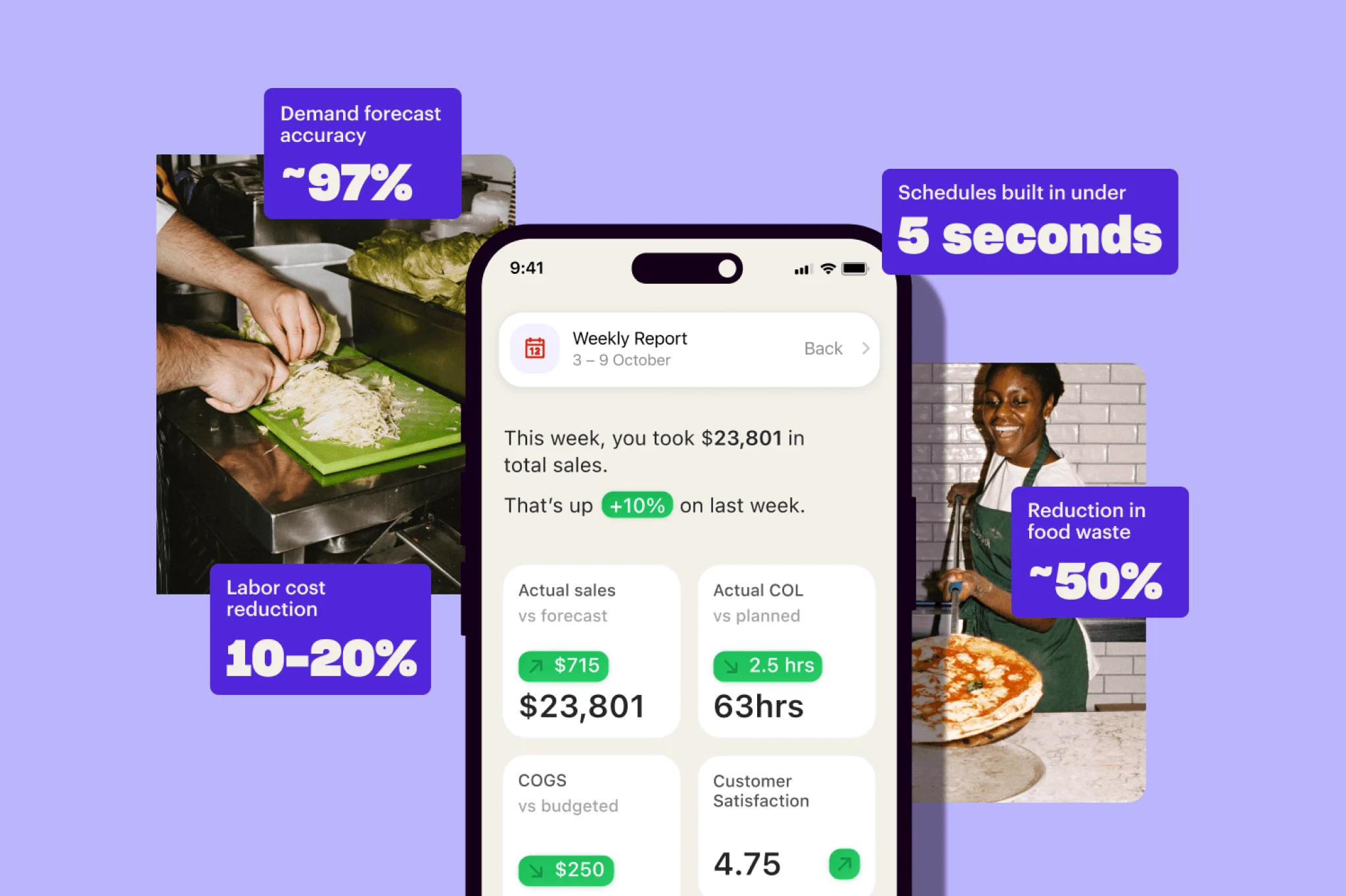
Modern restaurant platforms are also moving beyond AI assistants into agentic AI. While AI assistants (like Nory’s Ordering Assistant) provide recommendations, agentic AI can take approved actions on behalf of operators within predefined guardrails.
For example, Nory can:
- Automatically monitor performance across every location
- Identify issues as they emerge
- Make inventory orders based on forecast demand
- Optimise labour schedules using real-time trading data
Instead of spending hours reviewing reports, you can focus on running your business while AI continuously works in the background to improve performance.
Nory in action: Masa, a growing Mexican restaurant group in Dublin, used Nory to bring sales, inventory, labour, and performance insights into one platform. With Nory’s AI forecasting and real-time visibility, Masa achieved 97% sales forecast accuracy and controlled labour costs to within 1% of their plan.
Unlike traditional BI tools that require operators to jump between dashboards and manually interpret reports, Nory has business intelligence built directly into its restaurant operating system.
This means every recommendation is powered by live operational data rather than relying on disconnected reports or yesterday's data.
For multi-site operators, this is particularly valuable. Rather than manually checking dozens of dashboards across multiple restaurants, AI provides clear visibility of all locations and makes recommendations based on live operational data in the same system.
The result is faster decision-making, more consistent operations, and a business intelligence platform that helps you improve what’s happening right now.
How can you use agentic AI business intelligence to boost profits?
The best AI business intelligence platforms help you act on your performance data. By using AI to automate analysis and surface recommendations in real time, you can improve profitability while reducing manual work.
Here are a few ways restaurants can use Nory's agentic AI restaurant operating system to cut costs and increase profits:
- Forecast demand more accurately. Nory's Forecasting Assistant (coming soon!) predicts sales every 15 minutes with up to 97% accuracy, helping restaurants plan labour, purchasing, and inventory with far greater confidence.
- Build smarter staff schedules. Instead of creating rotas manually, the Scheduling Assistant generates optimised schedules in seconds using forecast demand, labour targets, employee availability, and trading patterns.
- Order the right amount of stock. Nory's Ordering Assistant recommends exactly what each location should order based on forecast demand, current inventory, supplier information, and historical sales.
- Monitor performance in real time. A lot of BI tools claim ‘real-time insights’, but they really provide data every few hours or at the end of every day/week. Nory updates every 15 minutes, giving operators live visibility into sales, labour, food costs, and profitability across every location. Managers can spot issues as they happen and take action immediately.
- Identify opportunities to improve margins. Nory continuously analyses operational performance and highlights where costs are increasing, margins are slipping, or productivity can be improved.
- Scale consistently across every location. As restaurant groups grow, maintaining consistency becomes more difficult. Nory gives operators a single view of performance across every site. As a result, it’s easier to replicate best practices and quickly support sites that need attention.
Nory in action: As Black Sheep Coffee expanded across the UK and US, managing consistency across a growing estate became more complex. By centralising forecasting, labour scheduling, and inventory management with Nory, Black Sheep achieved 98% forecast accuracy and kept labour cost variance below 1% of sales.
%20(1).webp)
FAQs about restaurant business intelligence
How is business intelligence used in the hospitality industry?
In hospitality, business intelligence provides insight into your restaurant performance. It helps you create benchmarks, identify market trends, and make informed decisions about your restaurant in real-time.
How do you gather business intelligence for your restaurant?
It depends. You can collect business intelligence data from different sources, all depending on what information is most important to your restaurant. With Nory, for example, you can collect inventory data, sales and performance insights, productivity levels, and more.
Business intelligence vs restaurant performance analytics: What’s the difference?
Restaurant performance analytics typically focuses on collecting and presenting historical data, while business intelligence goes a step further by analysing current performance, identifying trends, and helping operators make better decisions about the future.
Restaurant performance analytics often brings together key metrics like sales, labour costs, food costs, and profitability into dashboards or reports. Operators can then understand past performance and spot areas for improvement.
Business intelligence, however, uses this data more dynamically. It combines historical and real-time information to identify patterns, highlight issues, and make predictions about what could happen next.
Analyse restaurant performance with Nory’s agentic AI operating system
Business intelligence helps restaurants turn operational data into better decisions. When you combine BI with AI, those insights become real-time recommendations that help reduce costs, optimise labour, improve inventory management, and increase profitability across every location.
That's exactly what Nory’s agentic AI is built for. Our real-time business intelligence, AI assistants, and automation is built into your day-to-day operations. That way, you can make faster, smarter decisions that improve performance at scale.
Ready to see how AI can transform your restaurant operations? Book a call with the team!